
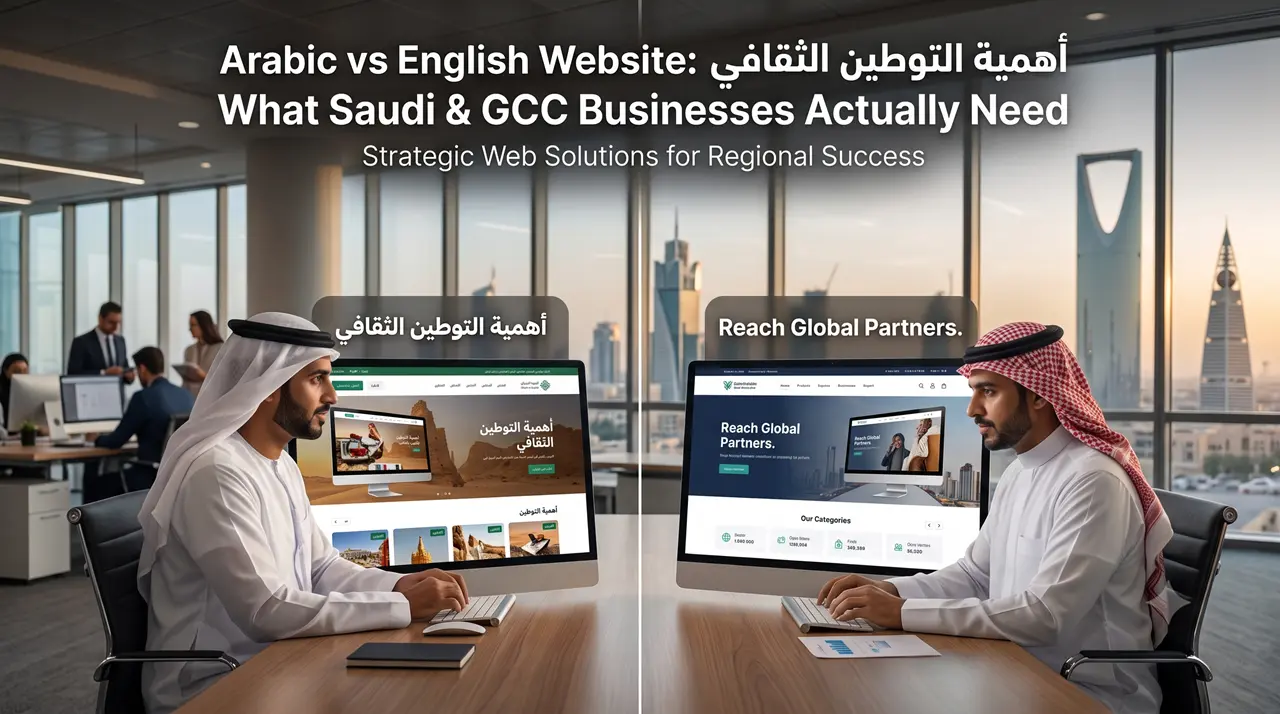
Introduction
A Saudi business website has a unique challenge.
It may need to communicate with Arabic-speaking customers, English-speaking customers, international partners and expatriate audiences—all through the same digital platform.
That creates an important question:
Should the website be Arabic, English or bilingual?
For many businesses serving broad GCC audiences, a properly planned bilingual website can provide a better customer experience.
But simply translating English pages into Arabic isn’t enough.
Arabic Is More Than Translation
Arabic changes the visual structure of a website.
Arabic uses right-to-left reading direction.
That affects:
- Navigation
- Buttons
- Forms
- Icons
- Cards
- Tables
- Alignment
- Spacing
- Typography
A website should therefore be designed for RTL rather than simply translated after the English version is complete.
When Should a Business Consider a Bilingual Website?
A bilingual website can be particularly useful for businesses targeting:
- Saudi consumers
- Government-related audiences
- Local enterprises
- Healthcare
- Education
- Real estate
- Hospitality
- Ecommerce
- Professional services
- B2B companies
- GCC markets
However, not every website needs two languages.
The decision should be based on the audience and business model.
Arabic UX Must Feel Native
A common mistake is creating an English website first and then flipping everything horizontally.
Good Arabic UX requires more thought.
For example, a button that works perfectly in English may become awkward in Arabic because the text length changes.
A heading may occupy a different number of lines.
Navigation may become longer.
Cards may require different spacing.
Forms may need different alignment.
Good bilingual design anticipates these differences.
SEO for Arabic and English Websites
Bilingual SEO requires more than translating keywords.
Search behavior differs between languages.
For example, users may search for a service in Arabic using one phrase while English-speaking users search using a completely different phrase.
Therefore, research should be performed for both languages.
Important considerations include:
- Separate language content
- Proper language targeting
- Relevant page titles
- Meta descriptions
- Internal linking
- Structured data where applicable
- Correct language relationships
- Local search intent
Don’t Automatically Translate Everything
Machine translation can be useful as a starting point.
But important business content should be reviewed by someone who understands the language and context.
This is especially important for:
- Legal content
- Healthcare content
- Financial services
- Product descriptions
- Corporate messaging
- Technical terminology
Natural language builds trust.
Literal translation often doesn’t.
Arabic + English for Ecommerce
For ecommerce, bilingual design becomes even more important.
Customers need to understand:
- Product information
- Pricing
- Shipping
- Returns
- Payment
- Account information
- Checkout
- Order confirmation
If one part of the buying journey suddenly switches language, customer confidence can drop.
The entire journey should therefore be considered.
Arabic Typography Matters
Arabic typography has its own visual characteristics.
The font must be:
- Readable
- Suitable for screens
- Consistent with the brand
- Available across devices
- Properly spaced
Using an inappropriate Arabic font can make even an expensive website look unprofessional.
Should Your Website Have Separate Arabic and English URLs?
For many bilingual websites, maintaining clearly separated language versions can make the site easier to manage and understand.
The exact implementation depends on the CMS and architecture.
The important thing is consistency.
The website should clearly communicate which version is Arabic and which is English.
Bilingual Websites Are a Business Decision
Don’t think of Arabic-English support simply as a design feature.
Think of it as part of your market strategy.
If your business wants to build trust in Saudi Arabia, Arabic can help communicate local relevance.
If your business works with international clients, English may be essential.
A bilingual platform can support both audiences when implemented properly.
Conclusion
For Saudi and GCC businesses, Arabic vs English should not be treated as an either/or question.
The better question is:
Who are your customers, what language do they prefer, and how should the digital experience adapt to them?
For businesses serving diverse audiences, a properly designed Arabic-English website can provide stronger usability, clearer communication and a more professional digital presence.
CTA
Need an Arabic-English website for your Saudi or GCC business?
Nexsiz Solution designs responsive digital experiences with Arabic RTL and English LTR requirements considered from the beginning.
CTA: Plan Your Bilingual Website →
FAQ
Is an Arabic website necessary in Saudi Arabia?
It depends on your audience and business. For businesses targeting Arabic-speaking customers, Arabic content can be highly valuable.
Can one website support Arabic and English?
Yes. A properly structured website can support multiple languages.
Is translating a website enough?
No. UX, layout, typography, SEO and content quality should all be considered.