
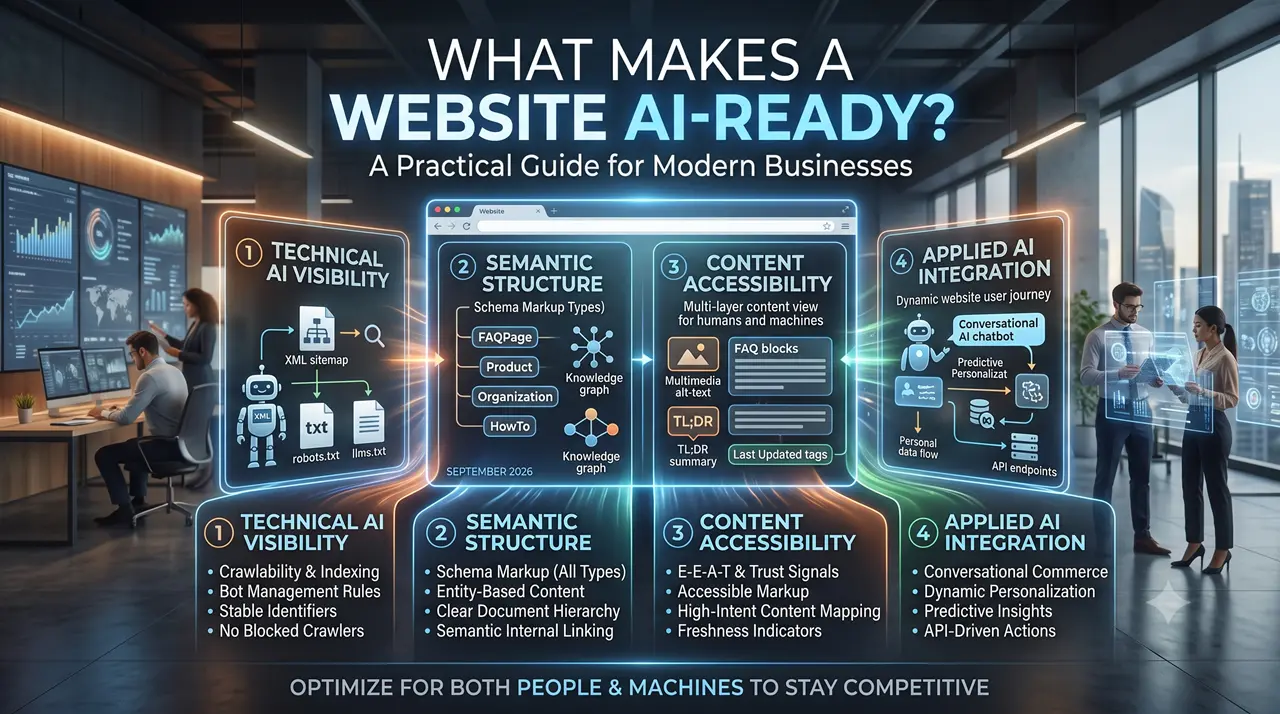
Introduction
Many businesses think adding an AI chatbot makes a website “AI-ready”.
It doesn’t.
An AI-ready website is fundamentally about architecture.
It should be capable of connecting structured business information, APIs, customer systems, automation tools and—where appropriate—AI capabilities.
The goal is not to predict every future technology.
The goal is to build a digital foundation that can adapt.
What Does AI-Ready Actually Mean?
An AI-ready website should ideally be:
- Structured
- Fast
- Secure
- API-friendly
- Mobile-first
- Accessible to machines
- Easy to update
- Connected to business data
- Capable of integrating with future tools
This is why custom website development can be valuable for businesses with more complex requirements.
1. Clean Information Architecture
AI systems need information to be understandable.
Your website should clearly separate:
- Services
- Products
- Locations
- FAQs
- Policies
- Team information
- Case studies
- Contact information
Instead of putting everything into one huge page, create logical structures.
For example:
Services → Website Development → Features → Technology → Industries → FAQs
This helps both humans and machines understand the website.
2. Structured Business Data
Imagine an ecommerce website with thousands of products.
If product information is inconsistent, incomplete or hidden inside images, it becomes difficult for both users and software systems to work with.
Structured information should include appropriate fields such as:
- Product name
- Description
- Price
- Availability
- Category
- SKU
- Images
- Specifications
The same principle applies to services.
3. API Integration
APIs are one of the most important foundations of modern digital platforms.
An API can connect your website with:
- CRM
- ERP
- Payment systems
- Booking platforms
- Ecommerce systems
- Mobile applications
- Marketing tools
- AI services
This means your website doesn’t have to operate as an isolated system.
4. Fast Performance
AI-ready doesn’t mean slow.
In fact, performance becomes even more important as websites become more sophisticated.
A modern website should be designed around:
- Efficient code
- Optimized images
- Fast hosting
- Caching
- CDN where appropriate
- Efficient database queries
- Mobile optimization
Google also continues to emphasize good page experience and technical accessibility.
5. Human-Friendly Content
Don’t write content only for machines.
AI search and AI systems ultimately exist to help people.
A service page should clearly explain:
What do you offer?
Who is it for?
What problem does it solve?
How does the process work?
What should the customer do next?
This is much stronger than filling a page with technical terminology.
6. Arabic + English Architecture
For Saudi and GCC businesses, bilingual capability can be an important part of future-ready design.
A website should not treat Arabic as an afterthought.
A proper bilingual architecture should consider:
- RTL layout
- LTR layout
- Typography
- Navigation
- Form alignment
- Buttons
- Tables
- Icons
- Spacing
- SEO metadata
- Language URLs
- Content consistency
This is especially important when a company serves both Arabic-speaking and international audiences.
7. Security
As websites become connected to more systems, security becomes increasingly important.
Businesses should consider:
- HTTPS
- Secure authentication
- Access control
- API security
- Database security
- Backup strategy
- Secure integrations
- Monitoring
- Regular updates
The more systems connected to a platform, the more carefully permissions need to be designed.
8. Build for Integration, Not Isolation
A website built today may eventually need:
Website → Mobile App → CRM → AI → Analytics → Automation
If the original website is completely isolated, integrating these systems later can become expensive.
A scalable architecture considers future integrations from the beginning.
What Businesses Should Not Do
Don’t rebuild your entire website simply because “AI is trending.”
First identify your actual business requirements.
For example:
A local restaurant may need:
- Fast website
- Menu
- Location
- Booking
- SEO
A B2B manufacturer may need:
- Product catalog
- RFQ system
- CRM integration
- Distributor portal
A large ecommerce company may need:
- Product management
- Payment integrations
- Inventory
- Customer accounts
- Mobile app
- Automation
The correct architecture depends on the business.
The Future-Ready Website Formula
A strong modern foundation can be thought of as:
UX + Performance + SEO + Security + APIs + Structured Data + Scalability
Then AI can be added where it creates actual value.
This approach is more sustainable than adding random AI features.
Conclusion
The AI era doesn’t mean every website needs to become a complicated AI application.
It means businesses should stop thinking of websites as static brochures.
A modern website can become a flexible digital platform capable of connecting content, customers, applications, automation and intelligent systems.
Build the foundation correctly today, and you give your business more options tomorrow.
CTA
Building a new website?
Ask Nexsiz Solution about a scalable website architecture designed for today’s customers and tomorrow’s technology.
CTA: Discuss Your Website Architecture →
FAQ
Does an AI-ready website need an AI chatbot?
No. AI readiness is more about technical architecture, structured information, APIs and integration capability.
Can an existing website become AI-ready?
Often yes, depending on its technology, architecture and integrations.
Why are APIs important?
APIs allow different software systems to communicate and exchange information securely.