
Introduction
One of the most common questions businesses ask digital marketing agencies is:
“Should we run Google Ads or Meta Ads?”
There is no universal winner.
The better platform depends on:
- What you sell
- Who you target
- How customers search
- Sales cycle
- Budget
- Location
- Creative assets
- Website quality
- Conversion tracking
Google and Meta can both be powerful, but they solve different parts of the customer journey.
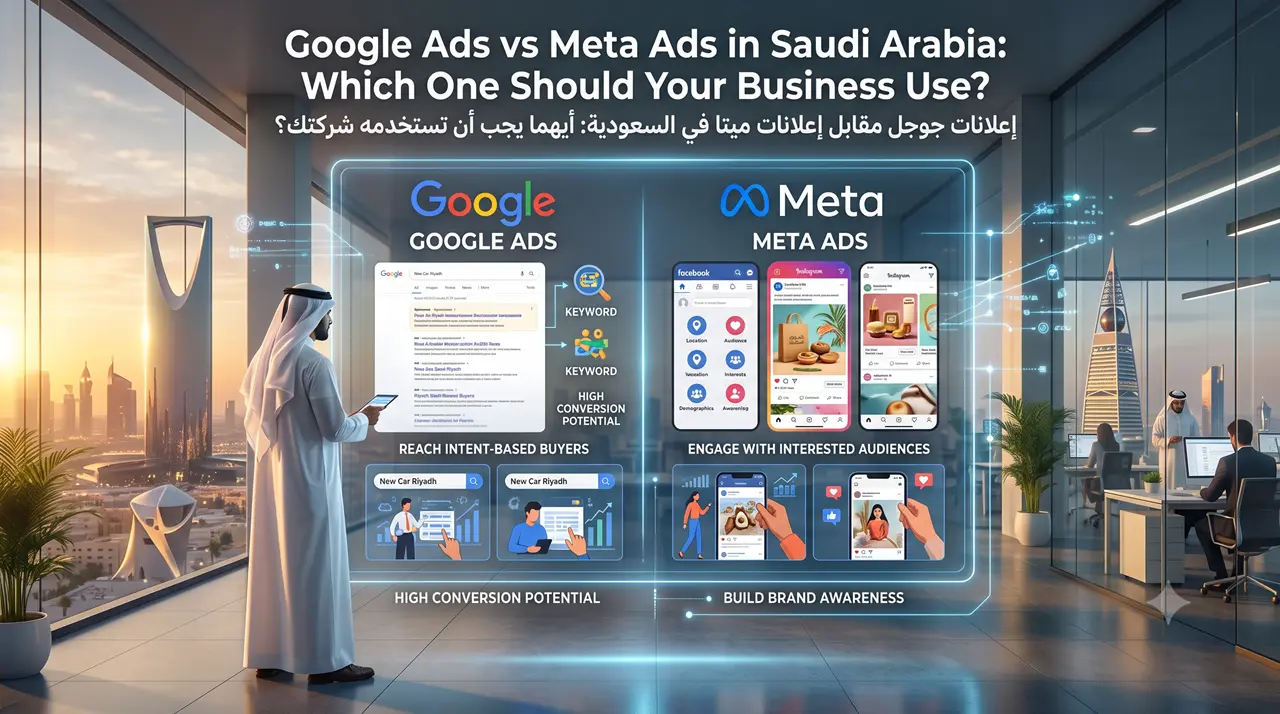
Google Ads: Capture Existing Demand
Google Ads can be powerful when people are already searching for the product or service you offer.
For example, someone searching:
“website development company Dammam”
already has a specific intention.
Someone searching:
“ecommerce website development Saudi Arabia”
is also demonstrating commercial intent.
This is one of Google’s major strengths:
capturing demand that already exists.
Meta Ads: Create and Influence Demand
Meta platforms such as Facebook and Instagram work differently.
Instead of waiting for someone to search for your service, advertising can introduce an offer or brand to an audience.
This makes Meta particularly useful for:
- Brand awareness
- Visual products
- Ecommerce
- Lead generation
- Remarketing
- Offers
- New product launches
The creative itself becomes an important part of the campaign.
Example: A Real Estate Company
Imagine a real estate company in Saudi Arabia.
Google Ads may target people actively searching for property-related terms.
Meta Ads could introduce developments, properties or offers through visually engaging campaigns.
A strong strategy might use both:
Google → Capture high-intent demand
Meta → Create awareness and generate interest
Example: A B2B Company
For a B2B technology company, Google can capture searches from people actively looking for solutions.
LinkedIn can also be relevant for professional audience targeting depending on the market.
Meta may play a supporting role for remarketing and awareness.
The correct mix depends on the customer journey.
Don’t Judge Ads Only by Clicks
Clicks are not the final goal.
A campaign can generate thousands of clicks and still be unsuccessful.
Businesses should track meaningful outcomes such as:
- Qualified leads
- Sales
- Revenue
- Cost per qualified lead
- Customer acquisition cost
- Conversion rate
- Return on advertising spend
The right metric depends on the business model.
Your Website Is Part of the Advertising Campaign
This is something businesses often overlook.
If an advertisement is excellent but the landing page is confusing, the campaign can still fail.
Your landing page should have:
- Clear headline
- Strong offer
- Relevant information
- Trust signals
- Fast loading
- Mobile-friendly design
- Simple CTA
- Easy enquiry process
Advertising and website experience should therefore be designed together.
Tracking Comes Before Scaling
Before increasing the advertising budget, make sure conversion tracking is working correctly.
You should understand:
Ad → Landing Page → Action → Lead/Sale
Without reliable tracking, it becomes difficult to know which campaigns are actually generating business.
Google Ads vs Meta Ads: Quick Comparison
| Factor | Google Ads | Meta Ads |
|---|---|---|
| Search Intent | Very strong | Lower |
| Visual Discovery | Moderate | Strong |
| Lead Generation | Strong | Strong |
| Ecommerce | Strong | Strong |
| B2B | Strong | Useful depending on audience |
| Brand Awareness | Moderate | Strong |
| Keyword Targeting | Yes | No traditional keyword targeting |
| Creative Importance | High | Very high |
| Remarketing | Strong | Strong |
The table is not a ranking.
It shows that the platforms have different strengths.
Why Businesses Often Need Both
The customer journey isn’t always linear.
Someone may:
- Discover your company on Instagram
- Visit your website
- Leave
- Search your brand on Google
- Read your service page
- Return through remarketing
- Submit an enquiry
This is why modern digital marketing should be viewed as an ecosystem.
AI Is Changing Paid Advertising Too
Advertising platforms are increasingly using machine learning and AI to automate parts of:
- Audience selection
- Bidding
- Creative optimization
- Campaign delivery
- Conversion prediction
This makes the quality of your inputs increasingly important.
Good:
- Accurate conversion data
- Strong creative
- Clear offers
- Quality landing pages
- Reliable tracking
Poor:
- Broken tracking
- Weak landing pages
- Irrelevant offers
- Low-quality creative
AI cannot compensate for fundamentally poor campaign strategy.
The Best Strategy for Saudi Businesses
Instead of asking:
Google or Meta?
Ask:
Where does my customer discover, research and purchase my product or service?
That answer should determine the advertising mix.
For some businesses, Google may be the primary acquisition channel.
For others, Meta may be stronger.
For many businesses, a combination works best.
Conclusion
Google Ads and Meta Ads are not direct replacements for each other.
Google is particularly powerful for capturing existing search intent.
Meta is particularly powerful for visual discovery, audience targeting, awareness and remarketing.
The strongest campaigns connect advertising with:
Strategy + Creative + Landing Pages + Tracking + Sales Follow-up.
CTA
Want to know which paid advertising strategy fits your Saudi or GCC business?
Nexsiz Solution builds performance-focused digital marketing campaigns across search, social and conversion channels.
CTA: Plan Your Paid Ads Strategy →
FAQ
Which is better for Saudi businesses, Google Ads or Meta Ads?
Neither is universally better. The correct platform depends on your business, audience, sales cycle and campaign objective.
Is Google Ads better for B2B?
Google can be very effective when potential customers actively search for the services or solutions you provide.
Is Meta Ads good for ecommerce?
Meta can be useful for product discovery, visual advertising, remarketing and ecommerce campaigns.
Why is conversion tracking important?
It allows businesses to understand which campaigns and channels generate meaningful actions instead of optimizing only for clicks.